
Executive summary
The European Critical Raw Materials Act (CRMA) represents a meaningful step forward in improving clarity for project developers, providing a clearer strategic framework within which projects are conceived, advanced and assessed. Greater policy alignment under CRMA is already enabling earlier engagement, more consistent signalling to investors, and a more coherent strategic context for project development.
While CRMA strengthens the policy environment, project outcomes continue to be determined primarily by technical delivery fundamentals, including processing definition, operability risk, permitting-critical integration, cost and schedule credibility, and demonstrable execution pathways. For projects to progress successfully, early technical maturity is a key success enabler. While it does not compress statutory permitting timelines, it reduces iteration risk and stabilises scope prior to key funding and permitting decisions. Conversely, stalled or unsuccessful projects commonly exhibit uncertain processing optionality, unconstrained scale-up risk, late integration of energy, water and residues constraints, and cost confidence that fails to meet the standardised engineering definition.
This paper outlines delivery learnings from numerous projects and is intended for experienced project developers. Appendix A aligns fundamental messaging to elements of the CRMA Strategic Project criteria.
1. Scope and audience
This paper is written for European project developers and investors active in extraction, processing, recycling and substitution projects. It focuses on delivery-critical technical considerations that materially influence permitting readiness, financing readiness and execution confidence under European conditions.
2. Delivery realities: why projects stall
2.1 Processing definition is the binding constraint
A recurring European pattern is that processing capability – not resource availability – becomes the binding constraint on delivery. Projects often progress through resource definition without an investment-grade processing concept that is simultaneously operable, permit-ready and financeable.
2.2 Technical maturity reduces iteration risk (not statutory time)
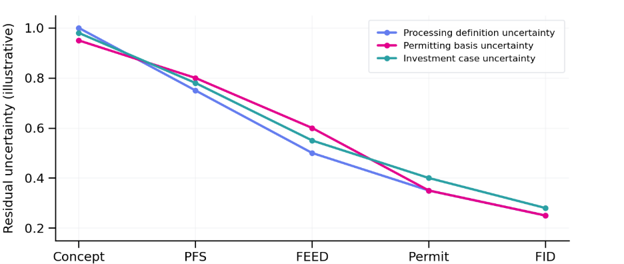
A key learning from projects that progress is that early technical maturity reduces iteration risk. Freezing the flowsheet basis of design, operability envelope (considering feedstock) and integration assumptions early reduces or eliminates redesign loops during permitting and diligence. In practice, unresolved integration and scale-up risks at this stage frequently translate into significant cost escalation and material schedule delay exposed through diligence or premature execution.
Technical Convergence Needed Before Funding and Permitting Gates (conceptual)
3. Integration-led engineering: permitting-critical interfaces
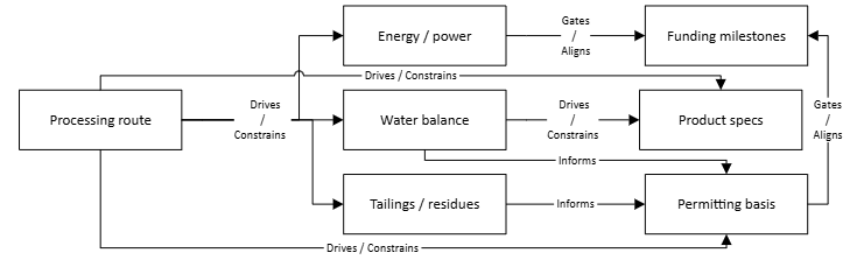
European regulatory and ESG expectations mean that energy use, water balance and residues management are not later-stage optimisations; they are base design drivers. Successful projects integrate these interfaces early to avoid late-stage scope changes that cascade into layout, compliance narrative and cost resets. Projects that treat these interfaces as secondary considerations typically encounter them later as binding constraints during permitting or design finalisation.
Integration dependencies that typically drive delivery risk
4. Learning from unsuccessful projects: Where delivery credibility breaks
Unsuccessful or stalled projects commonly fall short through compounding effects rather than a single deficiency. The most frequent failure modes include:
- Metallurgy and flowsheet definition that never becomes investment-grade
- Operability risk remaining unbounded through scale-up
- Energy, water and residues integration occurring too late to meet permitting conditions
- Premature scope freeze driven by external milestones
- Cost confidence overstated relative to engineering maturity
- Repeated schedule resets
- Downstream product specifications arriving after design freeze, and
- Financing deadlock due to unclear delivery pathway.
4.1 Technology readiness levels (TRL) as a root cause of project resets
A recurring feature of unsuccessful critical raw materials projects is misalignment between perceived technology readiness and the stage at which projects are advanced. In minerals processing, readiness is frequently overstated where immature metallurgical results or pilot tests are extrapolated to commercial-scale deployment.
Mineral processing sector readiness definitions highlight laboratory validation (typically TRL 4–5) and pilot or engineering-scale validation (TRL 6) do not delivery deployable systems. Readiness must be assessed at system level, including consideration of upstream variability factors, downstream residues management, utilities, operability, maintainability, and scale-up reliability.
In the case where technology maturity is assumed rather than evidenced, projects can progress into permitting and financing with unresolved and unexpected technical risk, leading to redesign, delay or abandonment when full-scale integration is attempted. A practical response is to treat TRL as a delivery control: identify critical technology elements, ensure their TRL are real, and align study maturity and cost confidence to the lowest TRL element in the integrated system.
| TRL band (mining context) | What has actually been demonstrated | Typical failure if overstated |
|---|---|---|
| TRL 1-2 | Basic principles observed; conceptual processing routes defined | Failure to launch by advancing with no empirical basis |
| TRL 3 | Proof-of-concept bench testing of individual steps | Integration overestimated or not feasible |
| TRL 4–5 | Bench/lab validation of core process step(s) | Overconfidence in recoveries, reagent behaviour, residue stability |
| TRL 6 | Pilot or engineering-scale integrated system in a relevant environment | Scale-up failures; utilities and materials handling underestimated; unexpected residue/water constraints |
| TRL 7+ | Full-scale (or near full-scale) demonstrator in a relevant operating environment | Fewer technical unknowns; residual risks dominated by delivery and interfaces |
| TRL 8–9 | Proven commercial operation over expected operating range | Performance drift and availability issues if operating envelope is narrower than assumed |
A large proportion of projects implicitly assume TRL 6-7 readiness, ignoring that elements at system level are at TRL 3-5. This gap between assumed and actual system level readiness is a consistent root cause of value erosion in European critical raw materials (CRM) project development.
The transition from pilot to commercial scale remains the single highest point of technical risk. Failure typically arises not from core chemistry, but from materials handling, heat transfer, residence time distribution and integration with utilities.
In practice, the consequences of misinterpreting technology readiness are most evident in misalignment between perceived maturity and the stage at which projects are advanced. Projects frequently progress into formal study phases, permitting or financing with unresolved system-level risks, particularly where pilot results are treated as evidence of deployability. This misalignment is typically only exposed during investor diligence or early execution, at which point cost, schedule and design assumptions are very significant penalties requiring a reset.
Failure to recognise this alignment typically results in overstated maturity and cost confidence, which is inevitably exposed during investor diligence and forms a primary cause of delay and rework. Projects that progress successfully typically exhibit a consistent sequence: early flowsheet convergence, staged demonstration of critical unit operations at increasing scale and integration of water, energy and residues constraints before front-end engineering design (FEED).
Maintaining this alignment in practice requires deliberate control of how projects progress through development stages. These principles can be distilled into a small number of practical controls that help maintain alignment between technology readiness and project progression:
- Do not advance study stage faster than the lowest TRL element in the system
- Treat pilot success as risk identification, not validation of commercial readiness
- Define and freeze energy, water and residues integration before FEED, not after
- Align estimate confidence strictly to demonstrated (not assumed) maturity
- Link process validation directly to offtake requirements and product specifications.
Projects that consistently apply these principles tend to avoid the compounding failure modes described in this section.
4.2 Investor expectations by development stage
Investor and lender technical diligence in critical raw materials projects typically converges on:
- Maturity of the processing design
- Evidence that key uncertainties have been closed at the appropriate stage
- Estimate and schedule credibility aligned to the maturity achieved
- A permitting and execution pathway that is demonstrably deliverable.
In practice, investor expectations at each development stage are closely aligned to implicit assumptions around system-level technology readiness. Where TRL lags the expectations of the study stage, the misalignment is typically identified during diligence, leading to reassessment of cost, schedule and execution risk.
| Stage | Indicative TRL (system level) | What investors expect to see (technical / delivery) | Evidence package (examples) | Where European projects commonly fall over / delay |
|---|---|---|---|---|
| Concept / screening | TRL 1-3 | Clear problem definition; credible route options; TRL explicitly defined and evidenced for any novel or critical technology elements; initial risk register. | Metallurgical test plan; preliminary flowsheet basis; early risk matrix and mitigations. | Advancing with unbounded variability, or treating pilot results as deployable system. |
| PFS / pre-FEED | TRL 4-5 | Trade-offs closed; early vendor and long-lead logic; estimate basis aligned to class; permitting pathway sketched. | Basis of estimate plan and estimate class rationale; early procurement and LLI market checks; decision log. | Permitting and community exposure emerges late; schedule becomes non-credible as interfaces expand. |
| FEED | TRL 6 | Project definition advanced to enable execution pathway; technology package selection; performance guarantee strategy; first credible CapEx and schedule. | Gap analysis and sensitivities; value engineering; LLI identification and budgetary quotes; vendor shortlist. | Scope freezes before data closure; procurement lead times and contracting strategies not validated. |
| DFS / bankability | TRL 7 | Definitive, single-option basis; bankable report quality; evidence that key risks are bounded and quantified. | Definitive/bankable study deliverables; independent review capability; integrated risk assessment. | Report maturity and standards gaps; late shifts in product specs or processing route; re-work and credibility loss. |
| Pre-FID diligence | TRL 7-8 | Independent technical due diligence on mining/processing; validation of assumptions; CapEx escalation logic and contingencies. | Due diligence verification of mining costs/physicals; processing failure points; CapEx accuracy checks; tailings strategy. | Cost and schedule reset triggered by diligence findings; residue/water/permitting constraints not integrated. |
| Construction / commissioning readiness | TRL 8-9 | Executable contracting model; commissioning and handover plan; operational readiness and ramp-up realism. | Commissioning strategy; performance testing approach; governance and controls; risk register tied to cost/schedule. | Product qualification or offtake conditions tighten as commissioning slips; repeated schedule resets. |
4.3 Divergence between client decision drivers and engineering delivery drivers
In many critical raw materials projects, delays and re-work arise not from technical error, but from a divergence between client decision drivers and engineering delivery drivers.
Client decision-making is often shaped by factors such as funding eligibility, milestone signalling, stakeholder alignment, preservation of optionality, and external visibility. These drivers are legitimate and frequently unavoidable, particularly in policy-adjacent or publicly scrutinised European projects.
Engineering delivery, by contrast, is constrained by cumulative technical realities: trade-offs must ultimately be closed, variability must be bounded, interfaces must be integrated, and technology readiness must be evidenced at system level. Projects encounter difficulty when this divergence remains implicit, for example through premature scope freezes to meet external milestones or deferral of flowsheet trade-offs to preserve optionality, resulting in iteration, delay or loss of investor confidence.
| Decision driver lens | Typical “good decision” in that lens | Delivery consequence if unaligned |
|---|---|---|
| Client / sponsor | Preserve optionality; meet an external milestone; maintain stakeholder alignment | Trade-offs deferred; scope freezes early; later redesign and credibility loss |
| Engineering / delivery | Close critical unknowns; lock integration assumptions; align estimate confidence to maturity | Decision timelines may feel slower, but reduces iteration and avoids late-stage resets |
| Investor / diligence | Reduce uncertainty; evidence readiness; validate execution pathway | Funding pauses or terms tighten if maturity and evidence lag the narrative |
5. Practical developer checklist: evidence that withstands diligence
Experienced assessors and financiers tend to converge on a consistent set of technical evidence requirements. The purpose is not to create documentation volume, but to demonstrate clearly bounded technical risk, credible integration assumptions, and alignment between engineering maturity, cost and schedule claims. The table below summaries the minimum evidence typically required to demonstrate delivery readiness at each stage.
Evidence package by delivery gate (illustrative)
| Gate | What must be true technically | Minimum evidence | Common pitfall |
|---|---|---|---|
| Concept | Processing route options narrowed; key risks identified | Metallurgical dataset plan; initial flowsheet basis; risk register | Over-optimised route selection with insufficient supporting data |
| PFS | Operability envelope clearly defined and bounded; integration assumptions stated | Mass/energy balance; variability testing; water/energy/residues basis | Leaving water/residues strategy open |
| FEED | Scope stabilised; estimate maturity aligned to level of definition | Design criteria; equipment list; estimate basis; contingency rationale | Presenting DFS-level confidence prematurely |
| Permitting / diligence | Compliance narrative consistent with design | Permitting pathway; environmental interfaces; decision log | Late design changes create permit re-work |
6. CRMA as a boundary condition
While the CRMA provides strategic direction and has materially improved policy clarity for critical raw materials projects, it does not remove the principal delivery and investment considerations that determine whether capital is ultimately committed. In the current CRM project development context, these hurdles are concentrated in a small number of recurring areas that directly affect bankability and risk allocation.
The most material investment hurdles observed across European CRM projects are outlined below, ordered broadly by frequency and impact rather than policy priority.
- Permitting duration and residual permitting risk are often key considerations in capital deployment decisions. Even for projects aligned with CRMA objectives, investors may apply caution to accelerated timelines where statutory approvals or consultation outcomes introduce uncertainty to project timelines. From an investment perspective, the critical issue is not nominal permitting duration, but the risk of design or scope change triggered during the permitting process.
- Processing and technology maturity represent the next largest source of friction. Projects relying on new processing routes, first-of-a-kind configurations, or unproven scale-up pathways struggle to translate strategic relevance into investment readiness. Capital decisions are typically influenced by the degree of demonstrable closure of technology readiness at system level, not laboratory or pilot performance.
- Confirmed material supply and feedstock security (bankable volume plus bounded quality/variability, evidenced through a defensible feed basis).
- Offtake security and product specification stability can be more complex to establish under current market conditions. Battery original equipment manufacturers (OEMs) and downstream counterparties remain cautious on long-term commitments amid chemistry evolution, demand uncertainty and price volatility. From an investor standpoint, weak, conditional or short-tenor offtake arrangements directly undermine debt capacity and equity risk appetite, regardless of CRMA alignment or strategic narrative. This is further reinforced by emerging regulatory requirements such as the EU Battery Passport, which increases the importance of early alignment between process definition, product quality and traceability.
- Capital intensity and cost confidence form a further gating item. European CRM projects are capital intensive and operate in an environment of constrained risk tolerance. Investors place a premium on clear alignment between engineering maturity and estimate class, with heightened scrutiny of downstream purification, residue management, energy integration and utilities costs. There is typically limited tolerance for scope ambiguity or late-stage cost escalation.
- Execution capability and governance increasingly differentiate projects at investment committee level. Projects that cannot demonstrate an integrated delivery model, credible contracting strategy and disciplined decision-making framework may experience delays or repricing even where technical fundamentals are otherwise sound.
Taken together, these factors underline that CRMA designation should be treated as an enabler rather than a substitute for delivery maturity. Projects that create credibly clear permitting pathways, technology readiness, offtake alignment and execution confidence can attract capital under current conditions. Projects that rely primarily on strategic designation without resolving these delivery fundamentals may face challenges progressing to FID on policy support alone.
In practical terms, this implies a shift in how European CRM projects should be developed and presented to the market. Developers should:
- Prioritise early closure of technology readiness at system level, ensuring that pilot and demonstration activities are explicitly designed to de-risk scale-up, integration and operability rather than to confirm isolated process steps
- Treat permitting-critical interfaces, particularly energy, water and residues, as core design drivers from the earliest stages, not defer these as optimisation variables
- Link offtake engagement directly to process validation and product specification development, reducing the risk of late-stage misalignment
- Ensure that project definition, estimate confidence and delivery strategy are governed by demonstrated maturity, with study progression paced accordingly.
Projects that adopt this integrated, delivery-led approach are materially better positioned to convert strategic relevance under the CRMA into bankable, executable outcomes.
Ultimately, successful CRM projects in Europe are distinguished not by strategic intent, but by disciplined alignment between technology readiness, engineering maturity and execution reality.
Appendix A. Short mapping to CRMA Strategic Project criteria (for submission use)
This appendix provides a minimal mapping of the delivery-led sections in this paper to Strategic Project application criteria.
| Criterion (Regulatory criteria) | Where addressed in this paper | Typical evidence pointer |
|---|---|---|
| Contribution to EU security of supply | Sections 2.1, 5 | Processing/recycling role, capacity logic, product pathway |
| Technical feasibility within a reasonable timeframe | Sections 2.2, 4.1, 4.2, 4.3, 5 | Maturity gates, bounded operability risk, schedule realism |
| Sustainable implementation | Section 3, 5 | Energy/water/residues integration; compliance narrative |
| Financing interface (Article 16 mechanisms) | Sections 4.2, 5, 6 | Investment-grade maturity, estimate basis, governance |
Appendix B. Investment friction heat map (executive view)
This heat map summarises the most common hurdles that materially affect investment decisions in European CRM projects and indicates where diligence and mitigation effort tend to concentrate.
| Hurdle | Investment impact | Likelihood / recurrence | Typical diligence focus | Mitigation emphasis |
| Permitting duration & challenge risk | Very high (FID gating) | High | Authority pathway, baseline completeness, change risk | Front-load permitting-critical integration; decision log; reduce redesign triggers |
| Processing & TRL maturity | Very high (risk premium / debt sizing) | High | Scale-up evidence, system TRL, operability envelope | Close TRL at system level; identify critical technology elements; staged demonstration |
| Offtake / spec stability | High (cashflow certainty) | High | Product spec, qualification plan, contract tenor/conditions | Early buyer engagement; impurity-focused test work; qualification samples |
| Cost confidence & CapEx escalation | High (equity + contingency) | High | BoE quality, estimate class alignment, contingencies | Transparent BoE; align estimate to maturity; value engineering; LLI checks |
| Feedstock security (volume & quality) | Medium–high | Medium–high | Contracts, blending plan, variability statistics | Secure feed agreements; blending strategy; conservative design margins |
| Energy / utilities & integration | Medium–high | Medium | Grid/energy assumptions, water balance, residues | Early utility studies; energy intensity mitigation; residue strategy |
| Execution model & governance | Medium–high | Medium | Contracting strategy, interfaces, delivery assurance | Integrated delivery model; interface management; controls and reporting |